
The Elephants in the Room
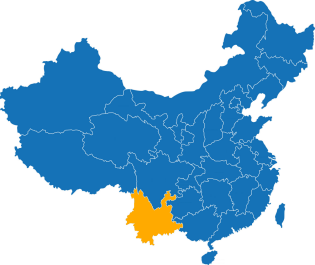
January 2026 · Xishuangbanna, China
For a long time I’ve been intrigued by this prefecture in China’s southwest, bordering Myanmar and Laos. The new high-speed train from Kunming finally made it an easy-to-reach destination. How would Dai (“Thai”) culture present itself in this region—and what about the roughly 250–300 gentle (?) giants in China’s last remaining elephant refuge?
My encounters in Jinghong, the largest city in Xishuangbanna, were mainly impressive creatures made of concrete or fiberglass, and a few formerly domesticated elephants that now live out their days carefree in Wild Elephant Valley.


In hindsight, I’m glad that I didn’t see any “wild” elephants. It means they still found a place to call home away from curious tourists like me. Stay wild and happy, my friends! Kunming is nice—but not suited for you.
Why do I mention Kunming in this context? Because in 2021, a small herd of about 15 wild elephants decided to go on a journey of their own.
They left the forests of Xishuangbanna and wandered north for hundreds of kilometers, passing fields, villages, and eventually reaching the outskirts of Kunming—a city of more than 8 million people. For weeks, the country watched as they slept, ate, and slowly made their way through unfamiliar territory—until they were gently guided back home.
Jinghong, Xishuangbanna

A calm start to the day, where Jinghong’s skyline rises across the river in light and reflection.

From across the water, the rounded towers almost resemble resting giants—present, but keeping their distance

The same skyline, now traced in light—somewhere between city and stage.

A quiet stretch of river, anchored by Jinghong’s main bridge.

Under the bridge, the river becomes a gathering place—fishing, walking, and watching the day unfold.

The river bends gently, carrying the city with it.

In China’s parks, it’s perfectly normal to bring your instrument along—practice, perform, or simply pass the time.

As the day winds down, the plaza fills with music, movement, and a rhythm that’s hard to resist.

No need to be perfect—just bring your energy and give it a try.

Along the Lancang, the night market seems to go on forever—food, lights, and a steady stream of people.

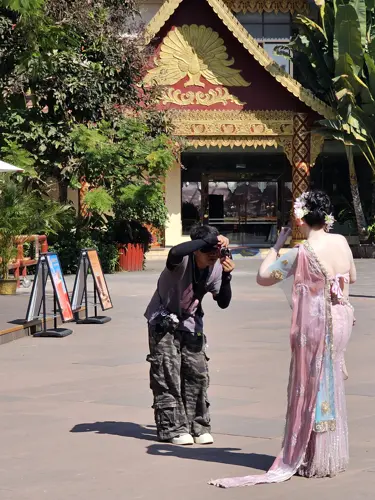
Costume rentals and styling studios are everywhere—step in, pick a style, and become part of the scene.


Manting Park

An open gateway into Dai architecture, history, and a slower rhythm of the day.

A cascade of color rising higher than the buildings—nature setting its own scale.

A quiet corner of Manting Park where reflections soften the edges of the day.
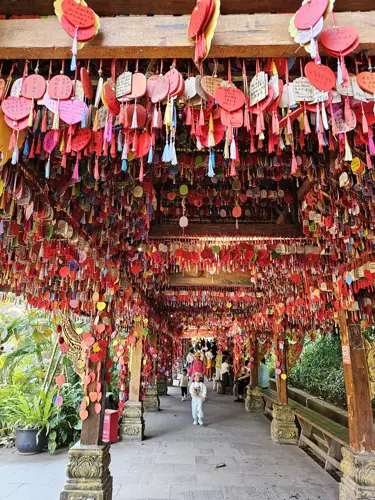
Visitors leave handwritten wishes on small plaques—hopes for love, luck, or simply a good life.

Layered spires and soft curves—architecture that feels just as at home across the border.

Graceful poses and golden details—scenes that could just as easily belong to a Thai temple courtyard.

Bridges, water, and layered roofs—an atmosphere that mirrors the temples of northern Thailand.
Wild Elephant Valley

An unexpectedly long and gentle ride above the forest—before the real walk begins.

Two first-time visitors to Xishuangbanna, meeting somewhere above the trees.

Needless to say, there were no elephants in sight—instead, a white-cheeked gibbon stole the show.
A Quiet Moment
Above, a lone glider—completely unexpected in this part of the world—traced slow circles in the sky, carried by invisible currents. I watched it for a long time and let my mind wander back to those happy days in Prachuap in 2022, when Andrew (Mac)—who passed away last year—took me paragliding, and to Wat Ao Noi. The sense of lightness, of freedom, of moments that pass and yet somehow remain, still lingers strongly.
(I wrote about those days here.)
Was it pure coincidence that I came across this lotus pond in full bloom, while everywhere else the lotus was still in deep winter slumber? Even in our dire times, it seemed to say: don’t worry—there is still hope.
Keep on soaring, my friend.

